
Now, About Yusei Kikuchi
Friday, I proposed Yusei Kikuchi as a player to look at should the Chapman bidding war get out of hand as expected. I’ve talked about him a little in the past, discussing the implications of his possible jump to the U.S., but I hadn’t profiled him to any length with regard to his abilities. Fortunately, not only do I do requests, I also get to ride in on the coattails of Larry Stone for the second week in a row, as he got a Sunday write-up giving the general overview. So, it falls to me to flesh out the scouting end of things.
Thus, Sunday afternoon, I watched a complete game of him pitching, no cuts or anything, just seven innings of the pure goodness that is Japanese prep baseball, with the cries of “taimuri hitto”, “shotto hoppu”, and of course, “san shin!” There were certainly a lot of those in this game, let me tell you.
Watching Kikuchi and Chapman in close succession is an interesting exercise. While Chapman has been drifting slightly into a more over the top motion, Kikuchi pretty much stays to his three-quarters and doesn’t seem to deviate from it all that much. Chapman also looks like he’s slinging the ball at times, whereas Kikuchi’s arm motion is more whippy. The majority of the stress seems to be in his arm, which alarmed me a little at first. I also noticed that, among other quirks, his arm can finish low and across his body and sometimes his trailing foot will drag forward as he decelerates. Aside from that, there aren’t any major mechanical concerns; the inverted W, which is in vogue now as the source of all pitching ills, was not present, nor did it look like he was otherwise putting a lot of strain on the other sensitive areas. His finishes weren’t always smooth, but his flaws were few for a pitcher of his age and generally correctable.
Getting into his arsenal, as was the case with Chapman, the 96 mph reading is about as much of an exaggeration as the 102 mph one. It is more Kikuchi’s style to stay in the high-80s range, but he is capable of reaching back for 92, 93 or 94, with about a 60% success rate, and will do so about fifteen times a game. His ability to hit his spots is otherwise solid. He doesn’t miss often, and when he does it tends to be down. Like Chapman, his pitches naturally trail from left-handed batters, so you don’t see him come in on them like he does versus right-handers, but that’s not so much of an issue at this point.
For secondary pitches, the next one up would clearly be the slider that clocks in the mid-70s. It has a great deal of lateral movement, but there were a few of them that had a sharp downward break to them and it’s clearly a pitch with a lot of potential and he recorded Ks on it at a rate roughly equivalent to his fastball. He also threw a slurve, not quite as often. His other offerings came and went as needed. For example, when a hitter led off the second with a double and the next batter came up intending to bunt him over, Kikuchi gave him a steady diet of two-seams, and while the run did come around (seeing eye single), the bunt was quickly fielded and the batter erased. He would continue to rely on it for the rest of the game. Also, I don’t know if it’s a common thing for him, but I did see him start out a batter in the first with a hilarious eephus pitch. It was taken for a ball and I didn’t see it again, but the batter had an expression on his face that suggested that he was going to go forward pretending that didn’t just happen.
His poise on the mound is another plus in his column. There were a couple of pitches that were tagged for hits when better defenders would have made the play. In one of the later innings, there was an infield hit to the first baseman, with the runner barely beating it out. No big deal. He struck out the next batter on five pitches and retired the one after him in similar fashion. While he is attentive to runners on the field, he doesn’t lose focus and his tempo is pretty much the same throughout, which ensures that he’s rarely on the defensive.
If we were looking at the same pitcher in a high school in the U.S., he’d be talked up at a potential first-round pick too. He looks like a kid who could add velocity in the future and everything else that you could ask for is present already. I would still put him as being three to four years out, easily, but if you’re in the camp that doesn’t believe Chapman is going to be ready out of the gate, that’s a tradeoff that you could probably tolerate. I’m not one to talk about the Mariners specific chance of getting him signed, or how much it would take, as this is a bit of a rare case (probably closer to standard NDFAs than Tazawa was), but I can say that he would be a top ten, or even top five prospect in most systems.
About Aroldis Chapman
Coming into the 2009 season, there were three pitchers in their early 20s that were singled out as having the talent to be MLB stars in the future: San Diego State’s Stephen Strasburg, Nippon Ham’s Yu Darvish, and HolguÃn’s Aroldis Chapman. Strasburg, as we all know, went number one overall, and Darvish has indicated no real desire to move to the MLB, but Chapman, who defected months ago while Cuba was playing in Rotterdam, has declared residency in Andorra and is eligible to sign as a free agent any time now.
Last weekend, Larry Stone profiled Chapman for the Times, alluding to the M’s interest and listing them as one of the teams in attendance when he threw a bullpen session in Madrid. Most of it is the standard fare; the M’s are players because they have money and Chapman has pitched against Ichiro in the WBC and knows about Felix, for whatever that’s worth. His agent, relative unknown Edwin Mejia, has thrown out the familiar line of his guy being the type of player that “comes across every 40 or 50 yearsâ€, and word is that Chapman is going to want $60m on the market, nearly double what Jose Contreras got from the Yankees years ago. So, is he worth it?
There are a few videos of Chapman pitching in online, from the ‘07 World Cup, to ’09 WBC preliminaries, to his WBC stint earlier in the year. The’07 video shows why it would be easy to get excited about him. He’s not the archetypal pitcher, he’s long-limbed and tends to throw from a high three-quarters slot like he’s slinging the ball to the plate, but the ball jumps out of his hands, looking much faster than the low-90s it was being clocked at, and has tremendous lateral movement. The follow-through is also workable, in that he doesn’t fall over, despite taking a few steps forward on some landings, and he manages to keep his eyes on the glove as he’s pitching. The curve, his second best pitch, was a low-70s offering, nothing eye-popping in terms of vertical break, but an effective pitch and one he seemed comfortable with. He’d only bust out the slider every now and then, which would come in about five to ten MPH faster and functioned as a third pitch.
The ’09 videos are a bit more revealing, being slightly more than the standard highlight reel. All his pitches seem to have gained a few MPH and he’s now throwing in the mid-90s with his fastball on a regular basis. This is out of line with his hype of hitting 102 on the radar gun. He can reach back for triple-digits, and I saw him do it, but this was not a regular occurrence. He seemed to have additional confidence with his slider and was more readily throwing it. The talent is all there, and he seems to be progressing, and those cover enough positives to warrant interest.
The negatives? Chapman is fundamentally a thrower. One would gather as much given that he ranked near the top in walks and wild pitches, in addition to strikeouts, during his tenure with HolguÃn. The same came out in the WBC. What I saw was his showing against Australia (going against former Mariner Travis Blackley), not the Japan game in which he ran into trouble. Even so, there were flaws that would be exposed elsewhere. His delivery has gone even higher over the past couple of years, but it’s as inconsistent as it was before. His tempo and his release points are both uneven. When he gets more over the top, he loses his fastball command. It’s difficult to say why he’d even be throwing there either, as his curves were best around three-quarters. So, the delivery, while not setting off injury warnings, is going to need ironing out in order for him to be in any way efficient.
As a result, he was giving the catcher a workout and probably hit his spots less than half the time. When he was missing, it tended to be up in the zone. Thus, the majority of his outs seem to come in the air. The other thing is that his fastball, when moving, tends to dart into the right-handed batter’s box and down. If he’s capable of pitching in to left-handers, I didn’t see him do it much, not that he really needed to. Chapman seems to live and die by his fastball command. Even with the tight, but unspectacular curve, the fastball was his out pitch, and more Ks came on that than any other.
We’re due to see the bidding war start any time now, with the usual competitors in the Yankees, Red Sox, and Angels. Chapman may get a huge paycheck, but realistically, you’re looking at a guy who isn’t going to be MLB-ready from the get-go. I’d put him as a year or so split between double and triple-A at least, just to get the mechanics in order. After that, you’re still hoping that the breaking pitches manage to develop a little more. They have so far, and are fine for how he uses them, but I wouldn’t call them plus pitches, or signature weapons (that would still be the fastball). If the bidding starts to get out of hand, and it might, I think the M’s would be better served going after Japanese prep left-hander Yusei Kikuchi, who will be meeting with teams next week in advance of the Oct. 29th NPB draft, and maybe adding Taiwanese right-hander Chih-lung Huang, who is also mulling over the idea of jumping the pond. You could probably pick up both and then some for less than it’s going to take to get Chapman alone.
There’s Just Not Much Going On
Sorry for going a couple of days without posting, but really, what was there to say? News is pretty scarce about now, and I’ve got some other things to tend to at the moment. One of those things will produce something you guys are going to love next spring, by the way. I don’t want to say too much prematurely, but it’s a fun project to be working on, and I’m pretty sure you guys will be thrilled with the end result.
Speaking of other things occupying my time, if you haven’t checked out FanGraphs lately, we’re blanketing the playoffs with coverage of all the games, plus tackling all the other interesting stories as they arise.
I’ll be back to tackle the 2010 Mariner roster next week.
Arizona Fall League Kicks Off
The AFL kicks off today, just in time to make up for a couple of days without baseball. If you haven’t heard, the M’s have sent an impressive group of prospects to represent them in Peoria – Dustin Ackley, Phillippe Aumont, Josh Fields, Nick Hill, Anthony Varvaro, Joe Dunigan, and Juan Diaz for now, with Carlos Triunfel replacing Diaz in a few weeks. You can follow the progress of the M’s top prospects down in Arizona starting today, and Geoff Baker is spending the week in Peoria covering the beginning of the AFL season.
The first game starts in about twenty minutes, but for M’s fans, it’s a bit of a disappointment. Joe Dunigan is the only Mariner representative in the starting line-up, and he’s DH’ing to boot. Ackley will probably get into the game a bit later, and you have to think he’ll be starting more often than not.
One word of caution, though – AFL statistics don’t really mean anything. Very few teams send high quality pitching prospects, so when you combine that with the atmosphere they’re playing in, offense is usually through the roof. A hitter can put up huge numbers in the AFL without actually improving at all. Don’t read too much into any of the performances. It’s just something fun to follow.
Roster Construction Theory
Before you ask, yes, the off-season plan post is coming. Patience.
Today, I want to spend a few minutes talking about a little bit of theory of roster construction that kind of gets lost when we begin to discuss the positives and negatives of certain moves. The concept is that of the escalating value of wins – is a four-win player more valuable than a pair of two-win players? Most people would say yes, and they base their conclusions on transactions around a paradigm that reflects that belief.
There is some real logic behind the theory. Regardless of resources, every team has to fill 25 roster spots. If you have a significant financial advantage, you don’t get to buy more players – you still only get to go into each game with 25 guys. So, in order to maximize competitive advantage, rich teams try to consolidate as much value as possible into the spots on a team that mean the most – the nine everyday players, three or four starting pitchers, and a couple of late-inning relievers. These 14 or 15 roster spots take up a bulk of the payroll, and the quality of a team is generally decided based on how much value you can cram into those 14 or 15 spots.
With a limit on how many good players you can have, the way for one team to beat another is to maximize value from those players. That constraint then serves to inflate the value of premium players. If you have a six win player at the same position your opponent has a three win player, he can’t make the two teams equal again by just adding a three win player, because those six wins cost him two roster spots. Your six win player and open roster spot is still a better arrangement for win maximization than his pair of three win players.
There’s also a scarcity of real premium players in baseball. There are perhaps a dozen or so guys who could be expected to put up six win seasons on a regular basis, so if you have one of them, the odds that your opponent also has one go down as well. Without a true superstar, you simply can’t build a roster that has as much upper-end potential. Even if you were able to fill out all 15 important roster spots with above average players and avoid any glaring holes in the 10 role player spots, you’d still be looking at a ceiling of something like 95 wins.
So, based on that, it should be fairly obvious that premium players are exponentially more valuable than combinations of lesser players, even with equal total win values, right?
Not necessarily. The potential upside is certainly higher, but value is not just derived by best case outcomes. In reality, value comes from the expected return and the inherent risk of not receiving that value. If you’ve ever invested in the market, you’ve certainly been told about the value of diversification, and how the best way to build wealth is to spread your investments around in order to avoid losing too much due to the failure of any one asset. The value of diversification is true in baseball as well, and works against the increasing value of wins for premium players.
Just as the upside of a team that has consolidated value into premium players is higher, so is the downside. If you have one six win player who hits the disabled list or suffers a significant drop in performance, you can lose the entirety of that value in a single blow. Ask the New York Mets about how quickly a few injuries can destroy a season – they lost double digit wins off their roster when Jose Reyes and Carlos Beltran missed huge chunks of the season this year. The fact that the Mets had two players of that quality was one of the main reasons the team was expected to be a force in the NL, despite some glaring problems with the rest of the roster. However, when they lost those guys, they took a massive hit from which they weren’t able to recover.
Premium players offer both more reward and more risk. For many people, they look at the increased reward and conclude that star players are more valuable, but they do not also account for the increased risk as well. Major League teams do, however.
The linearity of the value of wins is one that has been studied quite a bit by folks like Tom Tango (Mariner employee, noted statistical wizard). Over time, we simply do not see evidence that teams have been more willing to pay premium prices for premium players. Instead, teams have paid for wins on a linear scale at the current market rate. If you are a one win player in free agency, you’ve generally received the market rate for wins. If you’re a two win player, you’ve received double the market rate. Three wins, triple the market rate, etc…
Major League teams have looked the increased risks and rewards of consolidating value into a single player and decided that they’re basically an even trade-off. When faced with a choice of how much to pay for one six win player or two three win players, the dollar values are generally equal. The premium players get one tangible payoff that non-premium players do not, and that’s contract length.
The best players get really long deals – anywhere from six to ten years. Good but not great players get paid on the same linear scale, just for three or four years instead. In order to secure the rights to a premium player, teams are willing to give out longer guaranteed contracts, but not go significantly over the market rate in terms of wins added. If you’re a five win player, you’re going to get $20-$25 million per season, and all you’re really fighting for in negotiations is guaranteed years and perhaps some perks like a no-trade clause.
That teams see the risk/reward trade-off as mostly equal is interesting. I don’t think most fans do. You’ll remember that the people who liked the Erik Bedard trade from the M’s perspective were also those who were critical of the J.J. Putz deal – in both situations, they sided with the team that consolidated their value into the “best player” in the deal. There’s an old fantasy baseball cliche that you’ll still hear repeated from time to time – the team that gets the best guy wins the deal.
It’s just not that simple. Even if Erik Bedard had stayed healthy and pitched well over the last two years, the M’s would have still been big losers on that trade, because they paid a price far beyond what he was actually worth. They overestimated the value of having a star on the roster. The reward wasn’t as large as they thought it was, and they undervalued the inherent risks of tying your cart to one injury prone horse.
Premium players are great. But you have to be careful not to ascribe more value to them than they actually have. Building a team around a few really good players is one way to build a winning team, but it also introduces a higher level of risk than diversifying equal value over the entire roster. One way is not necessarily better or worse than the other. You can win with a core group of stars surrounded by competent role players (the 2009 Cardinals, for instance) or you can with a whole lot of good players and few great ones (the 2009 Angels).
Either way can work, as long as you execute it correctly and value players the right way. You can either bet on a few great players or a bunch of good ones, and both roads can lead to success. The key is correctly discerning how good a player is and what kind of value they really add.
The M’s hit home runs by diversifying last winter, turning one overvalued player into a bunch of undervalued ones. This winter, they might do the exact opposite, turning a collection of decent players into one better player. Just remember that, regardless of what kind of move they make, we still need to judge it on the merits of the individuals involved, and not on some big picture theory that doesn’t hold true. The team that gets the best player doesn’t always win the deal. One six-win player may not be more valuable than a pair of three win players. It all depends on the context.
Sorry, Jason, We Don’t Want You
Over the last few years, I’ve done an off-season series called “free agent land mines”, where I laid out players to avoid giving large contracts to who just weren’t going to be worth it. Because it was just that kind of organization, the M’s kept picking guys off the list and targeting them for acquisition, throwing big money at guys like Jarrod Washburn and Carlos Silva. Thank God those days are gone.
With a new regime in place that actually knows how to build a baseball team, I don’t really feel compelled to do a land mine post this year. This front office knows how to evaluate talent, and I have no fear that they’re going to go toss a bunch of money on a long term deal at an overrated aging veteran who has some mythical quality they think they need. A new day, a new way, and all that.
However, I did want to single out one guy whose name keeps popping up for a couple of reasons – the main one being that he’s local and still lives in the area. That he can hit is a nice bonus, since the M’s were last in the league in offense and all that, and for some people, the recipe of good hitter + from Seattle = guy we should be interested in. However, it’s a bad idea in a lot of ways. No matter how many people try to convince you otherwise, just say no to Jason Bay.
He’s 31 years old, right-handed, and not really much an outfielder anymore. He has classic old player skills. In fact, he’s eerily reminiscent to some other free agent the M’s blew a lot of money on.
Bay, 2009: .267/.384/.537, 15% BB%, 30% K%, .269 ISO, -13.9 UZR, +3.4 wins
Sexson, 2003: .272/.379/.548, 14% BB%, 25% K%, .276 ISO, -9.6 UZR, +3.9 wins
The numbers are from Sexson’s last healthy season before the M’s signed him – you’ll recall that he missed most of his contract year with a shoulder problem, but then went right back to being the player he was before the injury. Interestingly, Sexson was actually headed into his age 29 season when the M’s signed him, so Bay’s actually even further into his decline phase than Richie was. Richie made better contact than Bay does, if you can believe that. Their power levels were similar, and they both offset the low batting averages by drawing a bunch of walks.
In terms of skillsets, they’re basically the same player – quality (but aging) power hitters who don’t fit the park and play defense like a DH. These are the types of players that make the worst free agent signings. Power is overvalued in the market, while defense is undervalued, so sluggers almost always get paid more than they’re worth. Toss in the fact that this skillset doesn’t age well, and you have a recipe for disaster.
Even setting aside the presence of players like Michael Saunders (and, to a lesser extent, Dustin Ackley), the Mariners should have absolutely no interest in Jason Bay. He might be interested in playing closer to home, but that’s just too bad – I wouldn’t touch him with a ten foot pole.
Some team is going to give him a hefty contract this winter. Thankfully, it’s not going to be the Mariners. After making a huge mistake on this player type five years ago, the M’s aren’t going to do that again.
The Deciding Factor
Yesterday, we looked at what the M’s needed to do this off-season in order to get themselves into a spot where they could line up in April and call themselves legitimate contenders. It’s not an easy path – they need to add a bunch of wins without a ton of money to spend or a lot of obvious upgrades to make. But before they decide on any particular course of action, there’s one issue that has to be resolved, because it is the domino that drives the rest of the decisions all winter long.
I speak, of course, of Felix Hernandez. You all know the situation – 23-years-old, two years away from free agency, and just established himself as one of the game’s premier pitchers. His talent is unquestionable, and if he was a position player, you’d hand him a blank check for as many years as he would sign for. But he’s a pitcher, and the risk of giving long term, big money contracts to pitchers is remarkably high. The M’s don’t have the luxury of time anymore. This is the winter where they have to decide whether they’re going to give Felix a massive contract or not.
If they’re willing to accept the risk associated with a 4-6 year deal for a pitcher, then they have to make every effort to get him signed now. The opportunity to get a big discount has passed. He’s going to be a rich man whether he signs an extension or not, as he’s looking at a salary of around $10 million for 2010 even if he decides not to sign a long term deal here. In order to get him to give up the potential jackpot he’ll hit if he makes it to free agency in two years, the team will have to make him an offer that compensates him as one of the game’s premier pitchers for years to come. They’re going to have to set a new precedent, shattering every record for a contract given to a pitcher who isn’t yet eligible for free agency. Or else Felix will just take the risk and wait, and once he’s decided to do that, he becomes an asset with declining value the longer the M’s keep him.
In all likelihood, the choice will come down to giving him something like $100 million over 6 years or trading him.
Both paths have their risks and rewards. If you sign him to something like 6/100, you’re trying to win immediately. At that point, you’ve risked enough of your franchise’s future that you’re committing to trying to make it pay off with a division title starting in 2010. Now, instead of focusing primarily on finding young players to build around, the M’s would be in a position where the future takes a bit of a back seat to the present. Practically every pitcher is a time bomb headed for surgery, with the only question being when they go under the knife. Once you’ve guaranteed a massive paycheck to a starting pitcher, you’re running on borrowed time – you can’t sit around and try to build around that pitcher, because there’s a pretty decent chance that he’ll be hurt by the time the guys from your farm system get to the big leagues.
So, if you sign Felix, you’re looking for guys who can help you win right away. You’re putting Morrow on the block and looking for a more reliable #2 starter. You’re sending Mike Carp back to Tacoma and going with two veterans at 1B/DH. You’re in it to win it, because the clock is ticking, and if Felix’s arm blows up before you win anything, you’re going to have a hard time contending with a $17 million albatross on the books every year.
On the other hand, if you decide that you just don’t want to be the kind of organization that bets its future on a pitcher, and you’re not willing to meet Felix’s demands, you have to start taking offers for him, and no matter how good Jack Zduriencik is as a GM, the Mariners aren’t winning anything in 2010 without Felix Hernandez. You can try to get some major league ready players back in any Felix deal, but there’s no replacing a +5 win pitcher. You might get enough talent back to put together another .500 season with encouraging performances from a new young core, but you’re not winning the AL West without Felix.
That, obviously, leads to an entirely different kind of off-season plan. In a post-Felix world, you probably listen to offers for David Aardsma too, because the team can afford to not have a “proven closer” if they’re playing for the future. You give long looks to Saunders, Tui, Carp, and Moore next year rather than displacing them with better players who have less future value. You probably cut payroll again and try to create enough flexibility to make a big splash in 2011. But in this scenario, you’re admitting that nothing short of a miracle will lead you to the playoffs in 2010.
There is potentially a third option, but I’m not much of a fan of it and I hope it doesn’t come to pass. Theoretically, the team could keep Felix without signing him to a long term deal, put a team around him to try to win in 2010, and then shop him at the deadline if they’re not contending, but that plan requires too many assumptions for my liking. The Blue Jays just found out how tough it can be to try to extract premium pricing at the trade deadline when the Yankees don’t need pitching, the Mets aren’t in the playoff race, and the Red Sox realize they’re bidding against themselves. By waiting until July, you’re letting teams who will be interested this winter drop out of the race, creating a depressed market for his services. The “teams pay crazy prices at the deadline” theory has been mostly eradicated – if you want top dollar, you trade in the off-season.
So, before the team starts pursuing their off-season agenda, they have to figure out Felix. Are they willing to take the risks that come with huge contracts for pitchers? If so, go into winning mode. If not, then we’re still building for the future, and going after a very different type of player.
Felix’s future in Seattle needs to be determined before the team begins to make too many changes. It’s decision time. Pay up or trade him.
The Foundation
As the M’s come up with their off-season plan of action, there’s one significant evaluation that has to take place, and be accurate, or the plan will not succeed. That most necessary step is an evaluation of what the team already has on hand and how competitive they could be with the currently assembled roster, so that they know what they’re building from. As mentioned below, you can’t just assume that the team is starting from an 85 win benchmark and is attempting to build off of that, as there are numerous variables from 2009 that won’t carry over into 2010 – most notably, players on the team that won’t be returning, both good and bad.
In order to know both the kinds of moves to make and the magnitude of the work necessary, the M’s have to know how much talent they already have. We did this a few months ago, but let’s revisit the issue now that we have a bit more information about the roster as assembled.
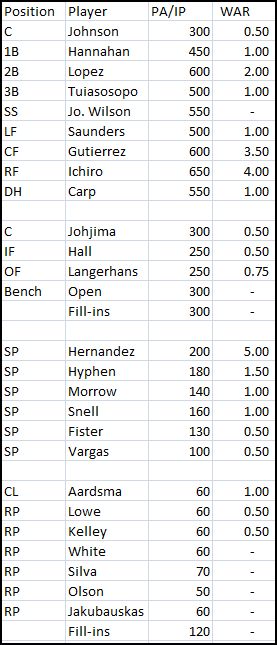
That’s essentially what the M’s have in house right now. Total WAR from that group? +27.25, which would make them team something like a 75-87 club. The offense would be painful to watch yet again, and the pitching would take a step back. Some expected regression from Gutierrez and Ichiro costs the team a couple of wins as well.
So, that’s where the M’s stand right now. They need to add somewhere between 15 and 20 wins to the roster this winter – that’s a pretty significant challenge. The group above would cost somewhere in the neighborhood of $70 million, give or take $5 million on either side due to uncertainty surrounding the salaries of the arbitration eligible guys (Felix, Gutierrez, Aardsma, Lowe).
That gives the M’s about $25 million to spend this winter. So, the team is looking at having to pay about $1.7 million per win. Wins cost between $4 and $5 million apiece in free agency, so obviously, just trying to buy players isn’t going to work. The M’s are going to have continue to get some a lot of bang for their buck if they’re going to get into the 90+ win arena for 2010.
That’s why the decisions about whether to try to bring back players like Jack Wilson and Adrian Beltre are a bit trickier than just looking at value produced divided by the cost of contract. In terms of market value, Beltre’s on field production is worth something like $10-$15 million for next year. Due to his poor season, he’ll almost certainly sign for less than that. However, if the M’s give Beltre, say, $8 million, they’ve bought an additional two wins, but at a price of $4 million apiece.
Realistically, the team can’t afford to spend 33% of its budget at a $4 million per win asset, when their target for the entire budget has to be $1.7 million per win. If you add those extra two wins and subtract $8 million from the budget, now the team would have to buy 13-18 wins with just $17 million. The rest of their moves would have to bring in wins at almost $1 million apiece, which is really, really hard to do.
So, the M’s have some tough decisions to make. Even if Adrian Beltre wants to return, they probably can’t afford to bring him back even at a discount unless they were willing to move the Hannahan/Hall platoon over to shortstop and say goodbye to Jack Wilson. There’s basically no way the team can have both Beltre and Wilson back next year. It’s an either/or proposition.
In lieu of more reliable veterans, the M’s are going to have to take some risks and have them pay off. Whether it’s going with a Hannahan/Hall platoon at third, trading Lopez for value and giving Tui a shot at second, or forgoing the big bat at 1B/DH and giving Carp a shot at regular playing time, they’re going to have to take a risk at one everyday position (maybe more) and hope someone develops faster than they might have expected. They just don’t have the cash to upgrade every single spot that’s currently held by a below average player.
15 to 20 wins for $25 million. That’s the bottom line of what this off-season needs to produce, and that likely means turning to the trade market, where a GM with a good eye for undervalued talent can get wins cheaper than through free agency. The M’s need to hit another home run in trade and get another high quality, low cost player on the team. If they don’t, it’s going to be tough to win next year.
WAR and the 2009 Mariners
A few facts you’ve probably heard tossed around the last few days:
1. The Mariners won 85 games
2. The M’s were outscored by 52 runs
3. Their pythag record, based on the above run differential, was just 76-86.
People have extrapolated all kinds of things from those facts. One of the more popular explanations for those three facts is that the team isn’t as good as their final record indicates, and that the extra wins are either due to unrepeatable good luck or the bountiful harvest of unquantifiable team chemistry. I’m here to say that both of those explanations are bunk.
Run differential is a decent tool when its used correctly and its limitations are understood. Good teams have large positive run differentials, bad teams have large negative run differentials, and teams in the middle are generally mediocre. It’s pretty hard to succeed without regularly outscoring your opponents, as should be pretty obvious, and no team is good enough to consistently win enough one or two run games to overcome a lack of talent. So, you can generally do a pretty decent job of projecting a team’s Win-Loss record based on RS-RA. No team was more than +/- 9 wins away from their pythag record this year, for instance.
That said, run differential is certainly not a perfect estimator of a team’s real abilities. Run totals can be skewed heavily by performance with men on base, either by hitters coming through in the clutch or pitchers stranding runners. In general, teams do not have a real ability to be significantly better or worse than you would expect in these situations based on their overall production, but over the sample of one season, teams performance can vary enough to affect their run totals. And that affects their pythag record, even though it’s not a real indicator of talent.
This can have a real impact on how people see a team overall. Not surprisingly to anyone who watched regularly, the Mariners were the worst hitting team in baseball with runners on base this year, hitting .254/.317/.396 with a man on. They were also worst in baseball at hitting with runners in scoring position, coming in at just .234/.312/.358. As a team, the M’s hit better with the bases empty than in pretty much any scenario where they had a chance to drive in a run (which is not normal, if you’re wondering), and while that’s frustrating to watch, it’s not an indicator that the M’s were really the worst offense in baseball – they were just a bad offense that failed in the clutch more often than they should have. And that skews their runs scored total down, which pushes their pythag record down, and, well, you get the idea.
Anyway, that’s a lot of words used to say that pythag is not luck independent, and shouldn’t be used as the be-all, end-all determinant of how “good” a team really was. In fact, we have a better way of measuring team talent level, and it’s one you should probably be familiar with by now – Wins Above Replacement.
You’ve seen us talk about WAR a lot. It’s the best measure of player value that we have, and while it’s not perfect, it’s pretty darn good. It sums up a player’s offensive and defensive value, as well as accounting for time on the field, and puts it on a scale over the production that could be expected from a pretty good Triple-A player would offer for the league minimum. At the team level, it’s the total of all the wins added by players on the roster throughout the year. And, because all of the inputs used in the formula are context free, it doesn’t know anything about the timing of specific events and isn’t affected by “clutch” performances in the way that run totals are.
WAR is a better indicator of talent level than pythag. And you know what WAR thought the M’s record “should be” this year? 83-79. The M’s got 21 wins from their position players (mostly thanks to their league best defense) and 16 wins from their pitching staff. Based on the calculations from FanGraphs, a replacement level team this year would have won ~46 games, so add those 46 wins to the 37 extra that the M’s got, and you have 83 expected wins.
In other words, the M’s weren’t a 76 win team that got really lucky or willed themselves to 10 extra wins through their harmony and hugging. They were a team that played well enough to finish two games over .500 and actually finished four games over .500. There’s nothing to explain. The M’s finished right about where we’d have expected them to, given how well they hit, caught, and pitched.
Don’t let the Pythag Police try to convince you that there’s an inevitable massive regression coming because the M’s outperformed their pythag. Their pythag underperformed their actual offensive level, and once you adjust for all of the facts that could be considered “luck” (not just some of them, as pythag does), you have to conclude that the M’s were basically the team that their final record indicates. There is certainly still a lot of work to do to get this team to be a playoff contender, but in order to know how much work needs to be done, you have to start from the right foundation. And that foundation is not pythag record.
Awesome bordering on creepy
“You can’t forget about him,” Suzuki said through an interpreter. “I believe that even in this winter, in my sleep, he will appear in my dreams.
“To play together with that hero of mine, in the same uniform — and on top of that, in Seattle — that time we got, even now, seems like a dream. I believe that time with him will continue.”
Also notable: Griffey could have made another $200k if they M’s had attracted “4,716 more fans” according to that article. I’m not sure if I agree with that — attendance was counted at 2,195,533 so you’d think the next milestone would be at 2,200,000 which would require +4,467 … but it raises an interesting question.
Why didn’t Griffey just buy up five thousand cheap tickets and give them to the local orphanarium or something? Write them off as a charity donation, and tada! Even if he was uncertain of how many tickets to buy headed into that last homestand and decided to buy a lot more than that, it’s still a really good gamble.