
Shh
I’ve been reluctant to say anything for fear of jinxing it, but the M’s haven’t made any crazy moves since the crazy Silva signing. They haven’t even been rumored to be close to any crazy moves. It’s a Christmas miracle!
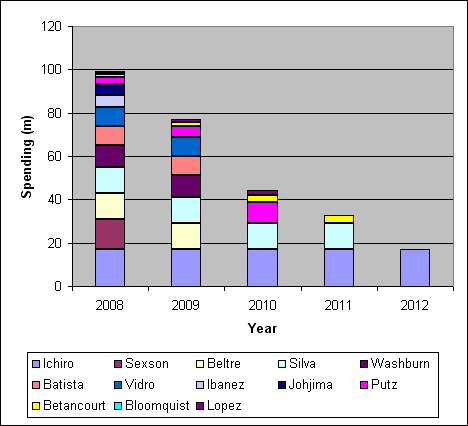
Mariner payroll commitments, 2008-2012
Drawn from CoT. Does include Vidro’s almost-certain-to-vest 2009 option he got in the trade from the Nationals. Does not (not) include mutual options, speculation about players headed into arb, and so forth.
A Paradox
So, while flying across the country today reading the 2008 Hardball Times Annual (which will get a post of its own soon), a thought hit me; the Mariners are signing Carlos Silva because they believe that his combination of no walks, no strikeouts, and some groundballs will lead to him not giving up many runs.
At the exact same time, the Mariners have built an offense that doesn’t walk, doesn’t strike out, and hits a lot of groundballs, believing that having a bunch of guys with that skillset will lead to the team scoring a lot of runs.
I wonder if they’ve even noticed that, much less tried to reconcile those two conflicting beliefs.
Four years and forty-eight million
Eeeeeeeeeeeeeeeeeeeeeeyup.
Geoff Jenkins signs with Philly
2 years, $13 million, for a high quality defensive outfielder who swings from the left side and has a swing tailor made for Safeco Field.
When you’re getting outsmarted by Pat Gillick, it’s time to do something else with your life.
Silva signing announcement later this week
The PI’s reporting “the Mariners could announce they’re signing him as early as Thursday.”
4y, $44m, as previously rumored.
Results of the attendance prediction contest
A long, long time ago, we asked readers to send in their guesses on what the high and low attendance at a game last season would be. The actual results:
Lowest attendance: 16,555 (May 2nd, hosting the White Sox)
Highest attendance: 46,377 (August 5th, hosting the Red Sox)
Going back through our email, I found that the best guess on the high *and* the low was by Perttu Soininen, who guessed 46,512 and 17,203 — only missing the high by 135 and the low by 648.
Congrats, Perttu. Good guessing.
Carlos Silva
Okay, so, obviously, the initial reaction to the potential Silva signing isn’t very positive. But, I know a lot of people still just look at innings and ERA and say “he’s not bad – what’s the problem?” However, as your broker has probably told you, past results are not necessarily indicative of future performance, and the M’s aren’t paying for what Silva used to be, but instead, what he will be going forward.
So, let’s take a look at what Carlos Silva’s actual skills are, and how those project into 2008 and beyond.
What Does He Throw?
Let’s take a look at Silva’s Pitch F/X card, made possible by the hard work of Josh Kalk. What we see right off the bat is that Silva is essentially a two pitch guy, primarily throwing a low 90s sinker (his version of a two-seam fastball) and a low 80s change-up. He also has a slider, but he hardly ever uses it.
The sinking two-seam fastball has several basic characteristics that are true in almost every instance, regardless of which pitcher is throwing it – it’s average in velocity, induces groundballs, is fairly easy to throw for a strike, almost never gets batters to swing and miss, and is far more effective against same-handed hitters.
Pitchers who feature a two-seam fastball often show significant platoon splits on that pitch, and if they don’t have a separate offering to keep opposite handed hitters off balance, they can often struggle. Silva uses his change-up to keep left-handed hitters off balance, but it’s clearly not as good of a pitch as his sinker – he doesn’t command it as well, it moves less, and since it’s 10 MPH slower, it can be a meatball if it’s not located correctly.
The slider is essentially a show-me pitch, used only when he’s ahead in a count where he’s going for a strikeout, and he only throws it when he can afford to miss out of the strike zone and hope the batter chases a bad ball. As you can see here, Silva actually doesn’t bury his slider in the dirt the way most pitchers do (think of everyone who ever pitches to Adrian Beltre), but instead throws it towards the outer half of the plate against RH batters and up in the strike zone. Because he doesn’t have much bite or velocity on his slider, it’s not a true outpitch – only 11 of the 110 sliders that the Pitch F/X system registered resulted in swings and misses.
So, from this, we can see that he’s primarily a sinker/change-up guy, with the change-up being a below average pitch, and the slider really being just for show. In scouting terms, he’s a two pitch guy with only one of those pitches being better than average, and it’s a pitch designed to induce contact.
Why Has He Been Successful?
With stuff that could easily be described as below average and an incomplete repertoire that usually gets a guy with his arsenal sent to the bullpen, Silva could certainly be described as something of an overachiever. After all, he’s thrown 945 innings in his five year career and produced decent results. How has he managed to pull that off?
Well, to start with, Silva has plus plus command – he can generally spot his pitches wherever he wants at any given time. The ball goes exactly where he wants it to go a huge majority of the time. Because of his pinpoint command, Silva’s been able to essentially eliminate the base on balls from games in which he pitches (he walked a crazy low nine guys the entire season in 2005), reducing the damage his opponents can do to simply putting the bat on the ball. if they don’t swing, he wins, every single time.
This approach can work quite well against bad hitters or when you have superior defensive players behind you. By forcing the opponent to put the ball in play in order to produce runs, you increase the variable outcomes that can occur. If your fielders make a bunch of great plays on hard hit balls, and you’re not walking anyone, well, you’re going to get a lot of outs. Or, alternately, if the hitters are a bunch of pansy slap-hitting ninnies (think Reggie Willits) who are just trying to get a walk so they don’t have to show everyone how weak they really are, then throwing the ball down the middle exposes their weakness.
However, this approach doesn’t work as well against hitters who can whack anything in the strike zone. When you’re hoping the hitter gets himself out and the hitter turns out to be David Ortiz, well, you’re in trouble.
How Does This Skillset Project?
While Silva’s built a nice little career for himself, the list of guys who have been able to sustain a quality level of performance through the throw-average-stuff-right-down-the-middle path to success is remarkably short. Essentially, the margin for error when you’re living off your command is tiny, and any loss in command can have disastrous consequences. Unlike a power pitcher who misses bats and can still dominate even if he’s lost a few MPH on his fastball, command artists have very little to compensate with for any loss of their primary skill. If his command goes from fantastic to just good, then there’s very little difference between Carlos Silva and any number of the hundreds of guys putzing around Triple-A waiting for an opportunity in the majors.
So, Silva’s success is essentially predicated on his ability to retain his otherworldly command, and in the history of baseball, there haven’t been that many guys who have been able to sustain that level of command for long periods of time. There are a few, but the odds are certainly not in Silva’s favor.
Is He A Good Fit For The Mariners?
Well, they’ve convinced themselves that they have to spend money on starting pitchers, and he’s a starting pitcher who wanted money, so maybe the answer is yes. But, if you dig deeper, I’d argue that the answer is a resounding no.
Because of his specific repertoire, Silva has some obvious strengths and just as obvious weaknesses. He’s strong against right-handed hitters, especially ones who try to hit the ball in the air or are patient, walk drawing types. He struggles against left-handed hitters, and he’s always going to run a larger than average platoon split; teams with lots of left-handed hitters will light him up.
The Mariners play in a park that is death to right-handed hitters but extremely friendly for left-handed power hitters. In other words, the Mariners park and Silva’s strengths are not complementary – they both take out the same kind of hitter. So, while Silva will give guys like Mark Ellis fits during games in Seattle, there’s nothing stopping Eric Chavez or Casey Kotchman or Jack Cust from jacking his sinking fastball down the right field line. Safeco’s not going to do anything to help his struggles against lefties, and there’s a significant diminishing return in terms of Safeco’s value to helping him limit right-handed hitters. If he’s already shutting them down on his own with groundball inducing sinkers, the fact that he’s got a cavernous left field behind him just isn’t that big of a deal anymore.
While Jarrod Washburn’s skills are essentially the perfect match for Safeco, Silva is the exact opposite of the kind of pitcher Safeco was built for. It will still help him, but it will help him significantly less than it would a different type of pitcher, meaning that the Mariners are still not building their roster to suit the specific advantages of their home park.
In addition, the Mariners already have two right-handed pitchers who throw a lot of two-seam fastballs and struggle against left-handed hitters. In many ways, Silva’s weaknesses are exactly the same as Felix Hernandez’s and Miguel Batista’s, and a team with a strong left-handed lineup is going to love facing the Mariners starting pitching rotation.
Mariners Close to Signing Carlos Silva
Per Ken Rosenthal, and confirming what I had heard earlier this morning, the M’s and Carlos Silva are not far from a four year agreement that would bring the strike-throwing, contact specialist to Seattle.
Yep – Carlos Silva, 4 years, $44 million. This organization never learns.
For Profit Business Adopts Capitalism
The Mariners announced today that they’ll be adopting a variable priced ticketing system, where seats at certain games cost more than others and people get a discount for purchasing early. The headlines, of course, will simply read “Mariners raise ticket prices”, and articles like the one in the P-I will make useless connections between the players salaries and the price of admission to one of their games, but that’s not the story here.
The Mariners, just like Microsoft, Boeing, Starbucks, or whatever other profit minded enterprise you’d like to pick, are in the business of maximizing revenue. Pricing based on supply and demand is, of course, a basic tenet that every one of these companies use. The sports world is just finally catching up, eliminating inefficiencies in their ticket pricing and putting basic capitalism to work for their businesses.
This isn’t the Mariners raising ticket prices because they’re raising payroll, or those greedy players costing you more money to take your family to the game – this is the Mariners charging more money for tickets because people are more than willing to pay the price to attend games.
Despite what you’re going to be told, there is no link between the team’s payroll and ticket prices, and the raising of ticket prices doesn’t mean anything in relation to the roster. It simply means that a for profit business is figuring out ways to make more profit by applying simple capitalistic strategies to selling its product.